

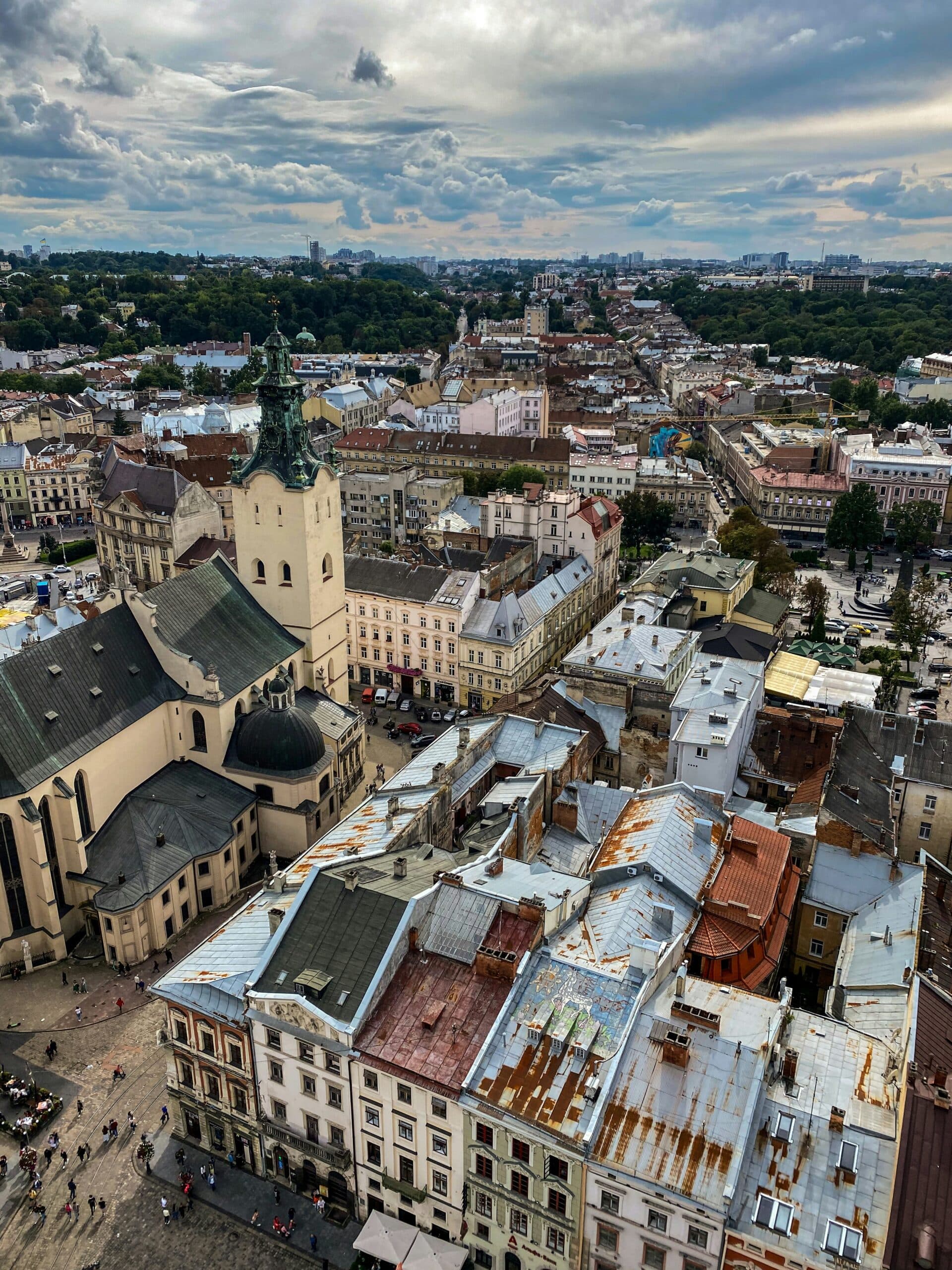
Lviv, Ukraine (formerly Polish/Austrian city) during its 800-year recorded history was arguably one of the most spiritually charged cities in Central-Eastern Europe. Its long history as Galicia’s capital placed it at the epicenter of Hasidism, Kabbala, heresy, Sabbateanism, Slavic pagan revival, and cutting-edge unconventional science simultaneously. Let’s review some of its most famous celebrities in that domain.
1. The Buber Dynasty — Kabbalistic Scholars & Jewish Mysticism
Salomon Buber (1827–1906) was born and died in Lemberg, a towering Galician Jewish scholar who produced the first modern editions of Midrashic texts and medieval Jewish literature, and whose estate and influence made Lemberg a center of serious Kabbalistic scholarship. Wikipedia
His grandson Martin Buber (1878–1965) is the more famous figure. When Martin was three, his mother left his father, and the boy was brought up by his grandparents in Lemberg — his grandfather Solomon dedicated his life to critical editions of Midrashim. Martin Buber’s writings ranged from Jewish mysticism to social philosophy, biblical studies, and religious phenomenology. He became the Western world’s foremost interpreter of Hasidic mysticism and authored the famous I and Thou — one of the most influential spiritual-philosophical texts of the 20th century. His deep engagement with Hasidism and Kabbalah began in Lemberg’s Jewish intellectual milieu. Encyclopedia BritannicaStanford Encyclopedia of Philosophy

2. Jacob Frank — The Most Dangerous Mystic-Heretic in Jewish History
Jacob Frank (1726–1791) made Lemberg the stage for one of the most explosive acts of mystical heresy in history. The Polish rabbis attempted to remove the “Shabbethaian heresy” at the assembly of Lemberg in 1722, but could not fully succeed, as it was kept alive mostly in secret circles which had something akin to a Masonic organization. Jewish Virtual Library
Frank claimed to be the reincarnation of the false messiah Sabbatai Zevi, preached a “higher Torah” based purely on the Zohar, and led his followers into deliberate antinomianism. In 1759, Jacob Frank arrived in Lemberg, where mass baptisms were celebrated with great solemnity in the churches — more than 500 persons converted to Christianity in Lemberg in the course of one year, among them Frank’s intimates and disciples. Frank himself was baptized in Lwów on September 17, 1759. JewishEncyclopedia.com
The Frankists operated like a secret society within a secret society — outwardly Catholic, inwardly Kabbalistic-antinomian. In 1759, the Baal Shem Tov was chosen to be one of three delegates representing the rabbis in a highly publicized debate with the Frankists in Lemberg. Chabad.org

3. The Baal Shem Tov — Father of Hasidic Mysticism (Debated Lemberg)
The founder of Hasidism, Israel ben Eliezer / Baal Shem Tov (c.1698–1760), was born in Galicia and his orbit directly intersected Lemberg multiple times — he was chosen as one of three rabbinical delegates in the major Frankist debate held in Lemberg in 1759. He reinterpreted Lurianic Kabbalah and created a new Jewish religious culture in which prayerful communion was exalted over Talmudic study, spiritual intention over ritual detail, and joy over melancholy. While not a Lviv native, Lemberg was a key arena in his spiritual battles. Chabad.orgPluralism Project
4. Volodymyr Shaian — Slavic Pagan Mystic & Sanskrit Orientalist
Volodymyr Shaian (1908–1974) was born in Lemberg and educated at the University of Lviv. He was a linguist, philologist, Orientalist, and Sanskritologist — and a pioneer of the Slavic Native Faith in Ukraine. In 1934, he had a spiritual revelation at the top of Mount Grekhit in the Ukrainian Carpathian mountains, which he said inspired him to seek a pagan renewal. He became the founding figure of a revived pre-Christian Ukrainian spirituality, combining deep Sanskrit scholarship with direct mystical experience — a very rare combination in early 20th-century Eastern Europe. Wikipedia
5. Adolf Beck — Pioneer of Brain Wave Science (Proto-Psychotronics)
Beck was appointed professor at the University of Lemberg (Lviv), where he founded the Department of Physiology and a modern electrophysiological laboratory. The discovery of electroencephalography is attributed to a trio: Richard Caton for his first brief description of brain waves, Adolf Beck for his extensive brain work in animals, and Hans Berger for making the recording technique applicable in humans. ResearchGateAcademia.edu
Beck was the first to describe EEG desynchronization following sensory stimulation — which became a foundational concept in neurophysiology. His principle of localized excitation surrounded by inhibition remains pertinent in current neuroscience. Academia.edu
From the perspective of psychotronics, Beck’s Lemberg laboratory was literally the first place in the world where spontaneous brain wave oscillations were systematically recorded and mapped — ground zero for all subsequent EEG, biofeedback, and brainwave entrainment research.
6. Leopold von Sacher-Masoch — Occult Sexuality, Utopian Mysticism & Sabbatean Connections
Leopold von Sacher-Masoch (1836–1895) was born in Lemberg and gained renown for his romantic stories of Galician life. During his lifetime, he was known as a utopian thinker who espoused socialist and humanist ideals in his fiction and non-fiction. Wikipedia

Less known is that scholars have drawn direct connections between Sacher-Masoch and Sabbatai Zevi — examining the intersection of masochism, philosemitism, and Sabbatean messianism in his work. His fixation on transgressive power dynamics, dominant feminine archetypes, and ritualized pain has been read by esotericists as an unconscious encoding of the Sabbatean antinomian tradition that saturated Lemberg’s Jewish underground for generations. His “Legacy of Cain” cycle was intended as a grand esoteric worldview — a complete philosophical cosmology of suffering, power, and redemption. Academia.edu
7. Richard von Krafft-Ebing — Psychopathia Sexualis & the Unconscious Map
Krafft-Ebing (1840–1902), who famously named “masochism” after Sacher-Masoch, was not born in Lviv but had deep scholarly connections to its intellectual culture. He represents the medical-occult fringe where psychiatry intersected with power, taboo, and altered states — territory that Lviv’s esoteric climate made uniquely fertile.
8. The Sabbatean Underground in Lemberg — A City-Wide Secret Society
Worth emphasizing as a collective phenomenon: the Polish rabbis attempted to place the “Sabbatean heresy” in herem at the assembly at Lwów in 1722, but could not fully succeed, as it was widely popular among the nascent Jewish middle class. For decades, Lemberg harbored underground Kabbalistic-antinomian circles operating with quasi-Masonic secrecy — practicing ritual transgression, studying the Zohar as a “higher Torah,” and maintaining hidden hierarchies. This makes Lemberg arguably the most significant city in the history of heterodox Jewish mysticism outside of Safed itself. Wikipedia